*⚠️ Verify before publishing: any Camus line must be confirmed verbatim and correctly attributed.
The closing idea below invokes the famous last movement of The Myth of Sisyphus; confirm the
exact wording of any sentence you present as a direct quote (translations differ), or keep it as
paraphrase as written here.*
---
Camus opened The Myth of Sisyphus with the claim that there is only one truly serious philosophical question, and it is whether life is worth living. Everything else, he argued, comes after you've answered that. I've been thinking that the age of the capable machine hands us a smaller cousin of that question, aimed not at life but at labor, and it turns out to be harder to shrug off than it looks. Why do we work, when the machine can do the work?
Start with the answer everyone gives, because it's true and because it dissolves in your hands. We work because we must live. We need money, money comes from work, and so we work. It is the plainest fact in the world. But look at it a second longer and it eats its own tail: you work so that you may live, and you live so that you may keep working, and the circle closes and explains nothing. It tells you why you can't stop. It never once tells you why the stopping would feel like a loss. And it does feel like a loss. That's the part the paycheck can't account for.
Because if work were only the boulder, only toil, only the thing we'd shed the instant we could afford to, then automation would be pure deliverance, and we would greet each new capable machine with unmixed joy. We don't. Something in us flinches. Watch a craftsman whose craft gets automated and you'll see grief where the theory predicts relief, and the grief is data. It's telling you that the work was never only the paycheck. Somewhere in the doing of it (the problem held and turned and finally solved, the thing made well, the small daily proof that you are competent in the world and it bends a little to your hand) was meaning, smuggled in under the cover of necessity. We told ourselves we worked to live. We were also, quietly, living to work, and we didn't have to examine which was which because necessity kept them fused.
The machine is prying them apart. That's the real disturbance under the productivity numbers. For the whole history of the species, meaning and necessity in work came bundled. You couldn't get the paycheck without doing the thing, and the thing, done, gave you the meaning as a kind of unbilled bonus. Now the doing can be handed off. The necessity can, increasingly, be satisfied without you. And what's left, standing exposed with the necessity stripped away, is the question we never had to ask because the answer used to be forced: if you didn't have to do the work, if the boulder rolled itself, would you still want to push?
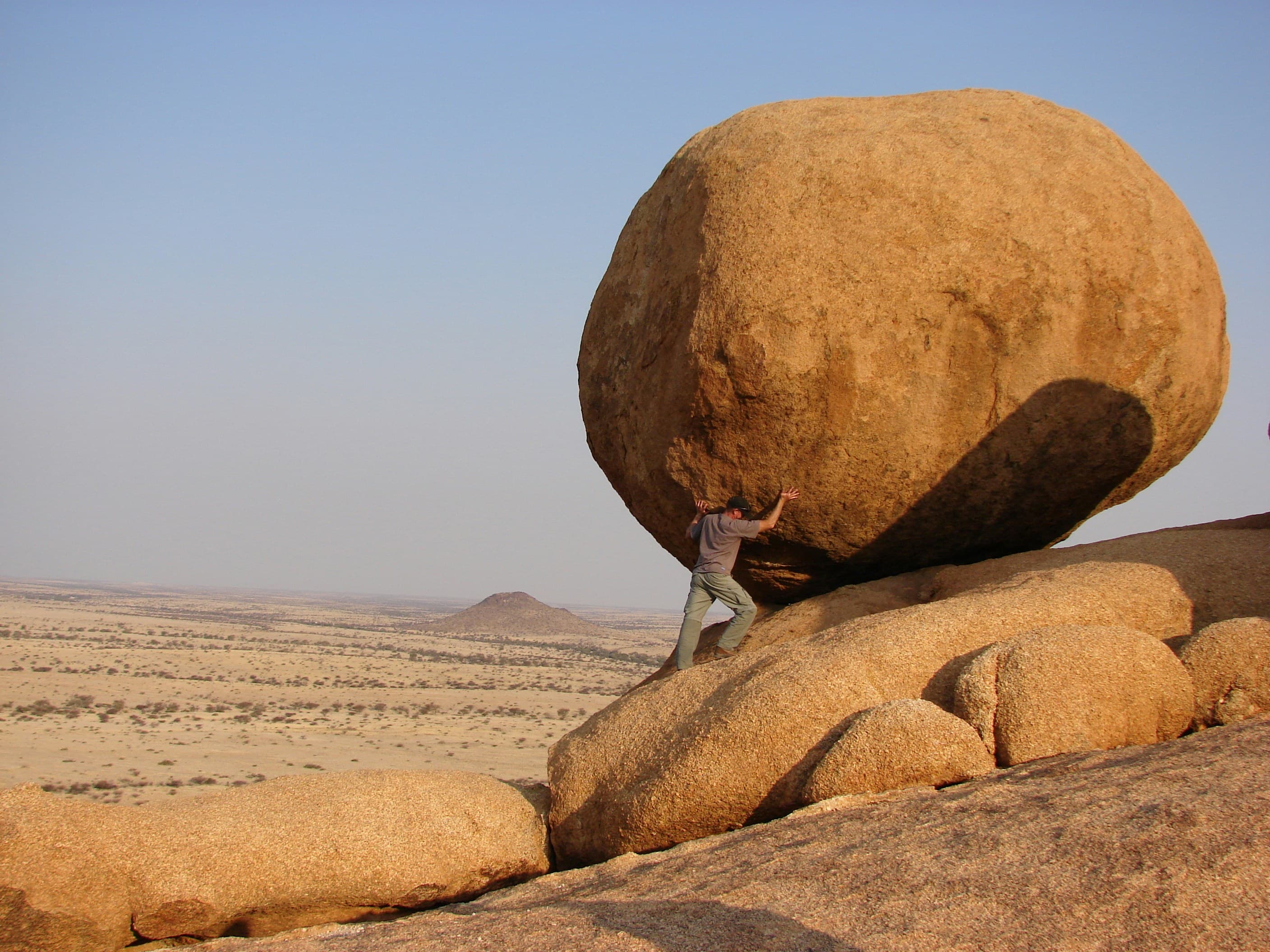
Camus imagined Sisyphus at the top of the hill, watching the rock roll back down, and found in that exact moment (the descent, the pause, the man walking back to begin again) not despair but a strange freedom, the freedom of someone who has looked at the absurdity dead-on and chosen the boulder anyway. (Paraphrase; verify the wording of any line you quote.) But we're being handed a case he didn't quite imagine. Sisyphus is offered a way out. The rock will roll itself now. He can leave it at the bottom and walk away, free, forever.
And here is the whole question, the one the machine actually asks each of us: standing at the bottom of the hill, released, with the choice at last genuinely ours, what do we reach for?
I don't think the answer is the same for everyone, and I don't think it should be. But I notice I'm suspicious of anyone who's certain they'd walk away. I think we'll find that some boulders we were only ever pushing because we had to, and good riddance, and some we'd climb back down for even now, even free, because the pushing was never the curse. It was the point. The trick, in the years ahead, is going to be telling the two apart before someone else decides for us.
The machine can do the work. It cannot want to. That may turn out to be the only part that was ever ours.